
Cicada Killer Removal in Dallas–Fort Worth
Usually harmless — we'll tell you when it isn't
Two-inch ground wasps that dig burrows in July and August. The males cannot sting at all, and the females almost never do.
- BBB Accredited A+
- 5-year warranty on hive removal
- Same-day service most days
A wasp the size of your thumb, hovering low over the lawn, dragging what looks like a dead cicada into a hole it dug itself. It's alarming to watch and it's the reason this page exists — because most people who call us about cicada killers are describing something far less dangerous than it looks.
We'll give you the same answer on the phone that we'd give you in your garden: often, you can leave these alone. When you can't, here's what it takes.
What you're actually looking at
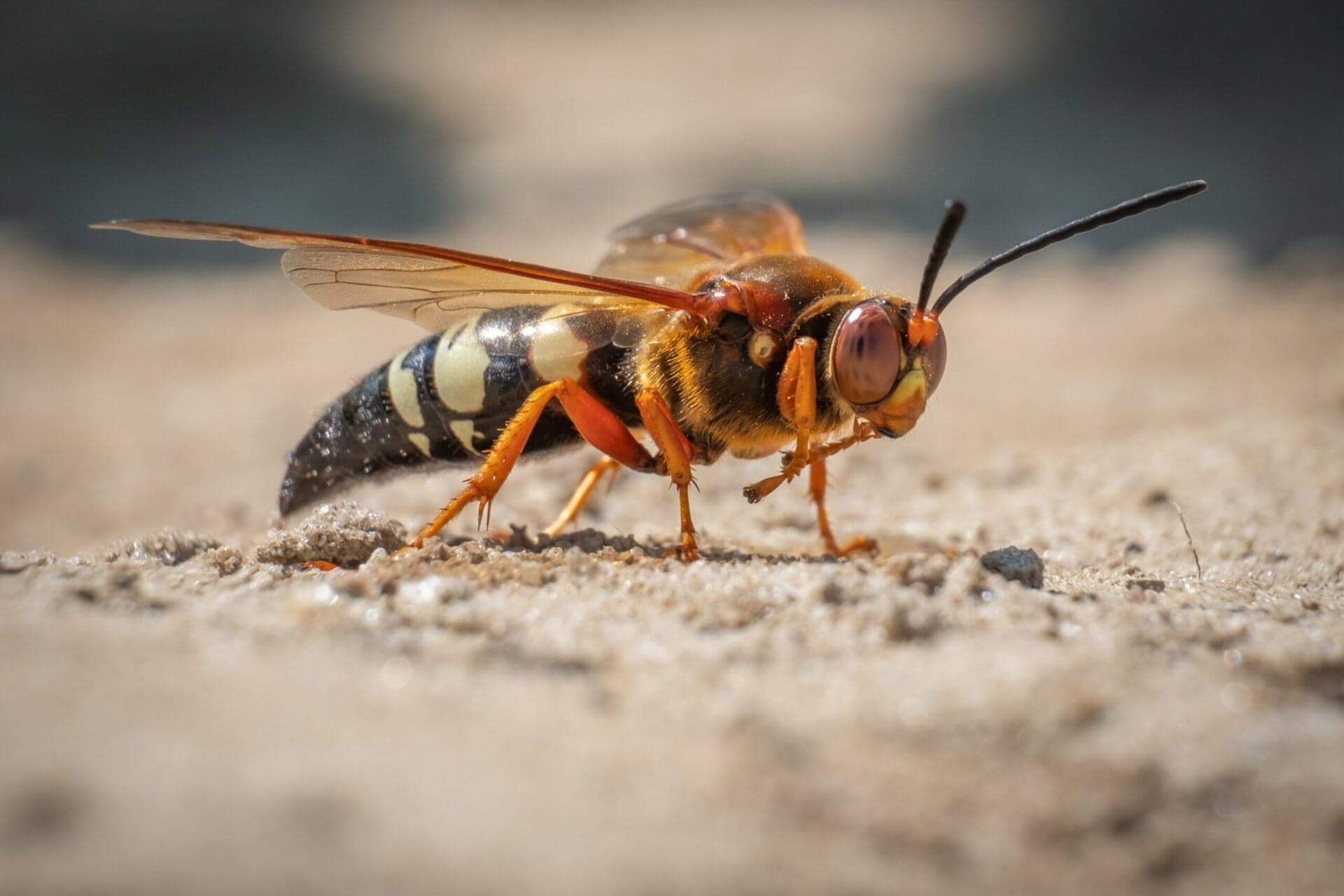
Cicada killers are among the largest wasps in the United States — up to two inches, rusty red and black, with amber wings. They appear in North Texas in high summer, roughly July into August, timed to the cicadas they hunt.
They're solitary, and that single word is why they're a different proposition from yellow jackets. There's no colony, no shared nest and nothing to defend as a group. Each female digs her own burrow, provisions it with paralysed cicadas for her larvae, and works alone. What looks like an infestation is usually several individual females who all liked the same patch of soil.
The males are the ones you notice, because they patrol territory at knee height and will fly straight at you. They also cannot sting at all — they have no stinger. The females can, and essentially never do unless you pick one up; they're busy, and they aren't defending a hive.
Cicada killer or yellow jacket?
Worth getting right, because the answer changes from "probably leave it" to "don't go near it."
| Tell them apart by | Cicada killer | Yellow jacket |
|---|---|---|
| Size | Very large — up to 2 inches | Small — about ½ inch |
| Colour | Rusty red and black, amber wings | Bright yellow and black bands |
| Social? | Solitary — one female per burrow | Colony of hundreds to thousands |
| The hole | Neat burrow with a fan of excavated soil | Worn entrance with constant two-way traffic |
| If disturbed | Flies off, or bluffs | Colony swarms and pursues |
The traffic pattern is the giveaway. A steady stream of small wasps in and out of one hole is a yellow jacket colony and needs treating properly. A big wasp making occasional trips to her own burrow, with a little mound of soil beside it, is a cicada killer.
When it's genuinely worth treating
Most years, for most gardens, the honest answer is to wait three weeks. They're gone by early September and they don't overwinter as an active nest.
There are real exceptions, and they're mostly about volume and location:
- Dozens of burrows in one area. A sandy, sparse, well-drained patch — a slope, a bunker edge, a bare strip beside a driveway — can attract enough females that the soil genuinely destabilises.
- Somewhere people walk barefoot or children play, where the number of low-flying males makes the space unusable even though nothing is going to sting anyone.
- Turf you're paying to maintain, on a green, a pitch or a commercial frontage, where the excavated mounds and holes are the actual problem.
- Someone in the household with a serious sting allergy, where "very unlikely to sting" isn't a good enough margin.
What we do about them
We locate the active burrows rather than treating the whole lawn, because scattered treatment misses burrows and does more to your grass than the wasps did. Then we treat at the burrow, where the female and the provisioned cells actually are.
Afterwards we'll talk about the soil, because that's the part that determines whether you see them again next July. Cicada killers choose bare, dry, loose, well-drained ground in full sun — so the thing that keeps them away is thicker turf, not stronger chemicals. Watering and overseeding a sparse patch does more than we can.
You get the price before we leave to come out, same-day most days. And if you describe it on the phone and it sounds like three burrows at the back of a lawn in August, we'll tell you to save your money.
What people ask us about cicada killers
Are cicada killers dangerous to people or pets?
Will they sting my dog?
Do cicada killers damage a lawn?
Will they come back next summer?
Can I just fill in the holes?
How long does cicada killer season last in DFW?
Where we handle cicada killer removal
Besides cicada killer removal, we also handle
Bees won't wait — and neither should you.
Call now for your bee removal needs and you'll have your price before we pull into your driveway. No bait and switch. No pressure. Just the truth and your call — from a beekeeping family that's been doing this for over 45 years.