
Wasp and Hornet Removal in Dallas–Fort Worth
Including the nests other folks won't touch
Eaves, ground nests, wall voids, chimneys and tree canopies — including the ones that need more than a ladder.
- BBB Accredited A+
- 5-year warranty on hive removal
- Same-day service most days
Wasps by the back door, a nest in the eave, something going in and out of a hole in the lawn. We've been clearing stinging insects across Dallas–Fort Worth since 1980, including the nests other outfits decline.
Describe what you're seeing and we'll tell you what it is, whether you actually need us, and what it costs — before we leave the shop.
Why wasps are a different job from bees
Honeybees sting once and die doing it. Wasps have smooth stingers and can sting repeatedly, and they recruit: disturb a nest and the colony responds together. That single difference is why a wasp nest is treated as a hazard and a honeybee colony is treated as a relocation.
It also changes the arithmetic on doing it yourself. A honeybee colony in a wall is a slow problem that gets more expensive. An active wasp nest by a doorway is an immediate one, and the failure mode isn't cost — it's a person on a ladder with dozens of wasps and nowhere to go.
If anyone in the household is allergic to stings: treat every nest as ours to deal with, not yours. A sting can trigger anaphylaxis, which is a medical emergency — difficulty breathing, swelling of the face or throat, a racing pulse. Call 911 first and us second.
Which wasp do you have?
The species decides the approach, the risk and the price, so it's the first thing we work out. Four cover almost every call we get in North Texas.
| Species | What you'll see | Where the nest is | How aggressive |
|---|---|---|---|
| Red wasp (paper wasp) | Rusty red-brown, long dangling legs, slim waist | Open umbrella nest you can see — eaves, shrubs, fences | Moderate; defends the nest |
| Yellow jacket | Short, stocky, bright yellow and black, hairless | Hidden — ground burrows, wall voids | High; swarms fast when disturbed |
| Bald-faced hornet | Black and white, noticeably large | Football-sized grey paper nest in trees or on eaves | High near the nest |
| Mud dauber | Slim, often metallic blue-black | Hard mud tubes on walls and under eaves | Very low; solitary |
Two of these have pages of their own, because they're most of our call volume and they behave nothing alike:
- Red wasp removal — identification, where they nest, and when a nest is genuinely worth leaving alone.
- Yellow jacket and hornet removal — ground nests, aerial nests, and nests inside a structure.
- Cicada killer removal — the very large ground wasp people mistake for a hornet, which is mostly harmless.
Not sure which you've got? Tell us the colour, roughly the size, and — most useful of all — where it's going in and out. An open honeycomb you can see and a hole in the ground point at completely different jobs.
The nests people call us about
Wasps will nest anywhere with shelter and a gap. Over 45 years the list has stopped surprising us: soffits and rooflines, chimneys, attic vents, wall voids, garage door tracks, outdoor outlet boxes, hose reels, barbecue lids, playsets, sheds, and the underside of every kind of patio furniture.
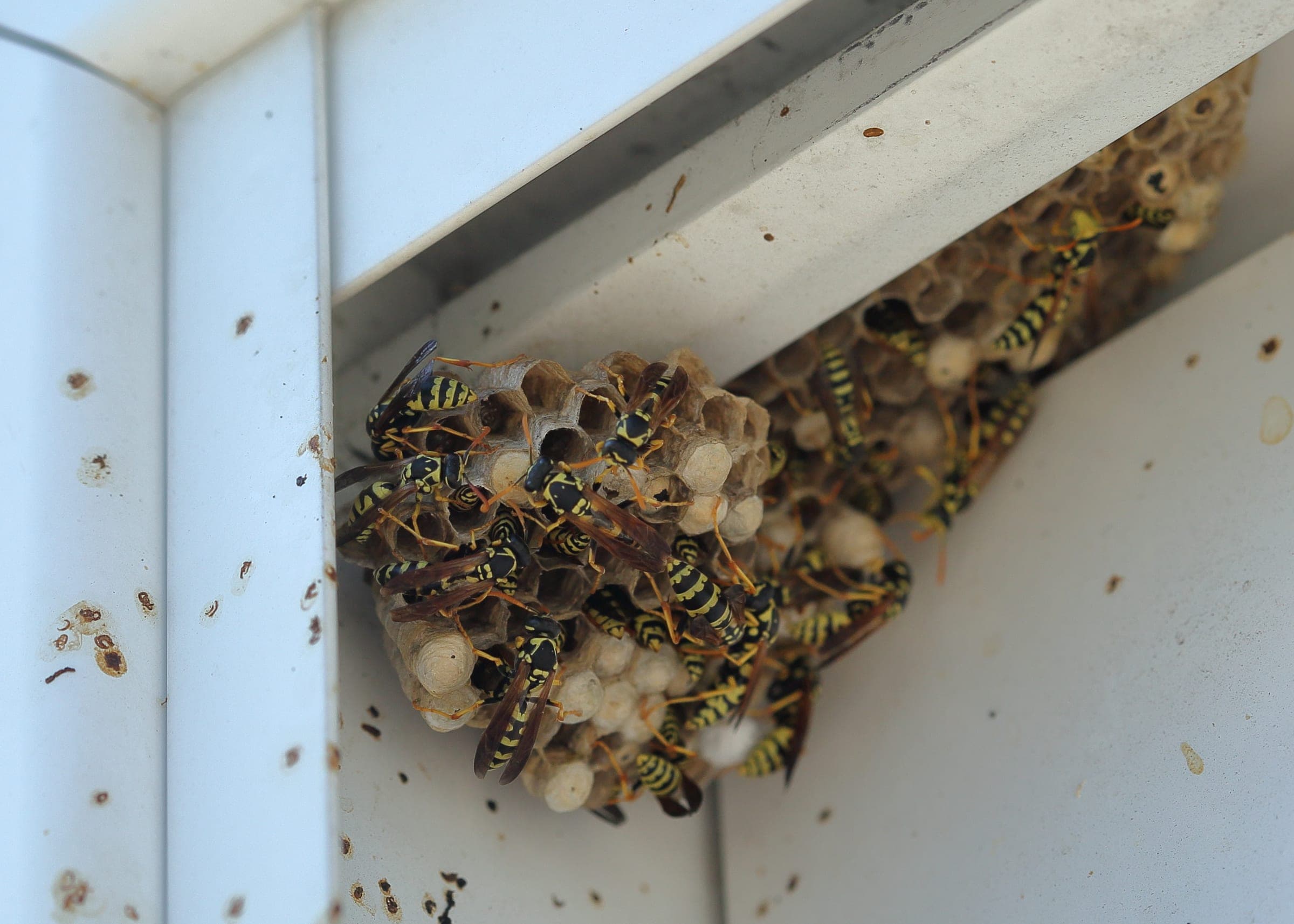
The ones worth calling about quickly are the ones you can't get away from — beside a door you use daily, over a walkway, near where children play, or next to an air conditioning unit that's about to be serviced. A nest at the back of the garden that nobody passes is a different conversation, and sometimes the honest answer is to leave it until autumn.
We carry the gear for the awkward ones: nests high on a roofline, deep in a soffit, inside a chimney, or up in a tree canopy. If you've found one you can't reach safely, the two things not to do are poke it and spray it from a ladder.
Can you do it yourself? Our honest answer
We'd rather talk you out of a job than sell you one you don't need.
Reasonable to handle yourself: a single small nest you can reach standing on the ground, treated at dusk when the colony is home and slow, with nobody in the household allergic. Mud dauber tubes, essentially always — they're solitary, they don't defend, and a scraper does it.
Worth calling us for: anything needing a ladder; anything inside a wall, soffit or chimney; a yellow jacket nest in the ground; a hornet nest of any real size; a nest beside a door, walkway or play area; and any nest at all if someone in the house reacts badly to stings.
The middle case is the one people get wrong: a nest that looks small from below and turns out to be the visible corner of something much larger inside a soffit. If you can't see the whole nest, you don't know how big it is.
Stopping them coming back
Clearing a nest solves this season. Whether you get another one next spring depends on why they chose that spot, so before we leave we'll point out what's actually attractive about it — an open soffit seam, a missing vent screen, a gap behind the fascia, an outlet box with no cover.
That's not an upsell, and we'll tell you plainly when a spot is going to keep attracting nests no matter what you seal. Some rooflines just do. Knowing that in advance is better than being surprised by it in April.
The honest answers
How much does wasp nest removal cost in DFW?
Can you reach a nest that's high up or inside the structure?
How quickly can you come out?
Will the wasps come back after you remove the nest?
Do you have to kill the wasps? Can't you relocate them like bees?
Is it worth waiting until winter, since they die off anyway?
Do you handle commercial properties?
Where we handle wasp removal
Besides wasp removal, we also handle
Bees won't wait — and neither should you.
Call now for your bee removal needs and you'll have your price before we pull into your driveway. No bait and switch. No pressure. Just the truth and your call — from a beekeeping family that's been doing this for over 45 years.