
Yellow Jacket and Hornet Removal in Dallas–Fort Worth
Ground nests, aerial nests, wall voids
The nest is usually out of sight — in the ground or inside a wall. We find it and treat the colony at the source.
- BBB Accredited A+
- 5-year warranty on hive removal
- Same-day service most days
Yellow jackets going in and out of a hole by the patio. A grey paper nest the size of a football under the eave. These are the two calls where we most often hear "I was going to do it myself, and then I saw how many there were."
They're the most dangerous stinging insects we handle, and unlike a honeybee colony there's nothing to save. So the job is to clear it properly, at the source, without anybody getting hurt.
Why these are the ones to leave alone
Yellow jackets and hornets sting repeatedly, and they coordinate. A honeybee stings once and dies. A yellow jacket colony defends as a unit, pursues, and can put dozens of stings on a person in seconds.
Ground nests are the worst version of this because you don't see them until you're on top of them — a lawnmower over the entrance, a strimmer through the hedge, a footstep near the hole. By the time you know the nest is there you're already inside its defensive radius, which is usually several metres.
If someone in the household is allergic to stings, treat this as urgent and don't go near it. Multiple stings from a disturbed colony are dangerous to anyone; for an allergic person they're a medical emergency. Signs of a severe reaction — trouble breathing, throat or facial swelling, a racing pulse — mean 911 first.
Yellow jacket, hornet, or something else?
All three of these get called "hornets" locally, and the nest location tells you more than the insect does.
| Species | What you'll see | Nest location | Aggression |
|---|---|---|---|
| Yellow jacket | Short, stocky, bright yellow and black, hairless | Ground burrows, wall voids, occasionally eaves | Very high — swarms fast when disturbed |
| Bald-faced hornet | Black and white, ¾–1 inch, noticeably bulky | Grey paper nest, football-sized, in trees or on eaves | Very aggressive near the nest |
| European hornet | Larger, brown and yellow | Tree hollows, attics, wall voids | Aggressive if threatened; active at dusk |
| Red wasp (paper wasp) | Rusty red-brown, slim, long dangling legs | Open umbrella nest under eaves and in shrubs | Moderate — see red wasps |
Describe the traffic pattern when you call. Insects disappearing into a hole in the lawn, a gap in the brickwork, or a soffit seam is a hidden nest and a bigger job. A visible grey paper structure hanging in the open is an aerial nest, and we can usually price it from a photo.
The four situations we get called to
Yellow jackets in the ground
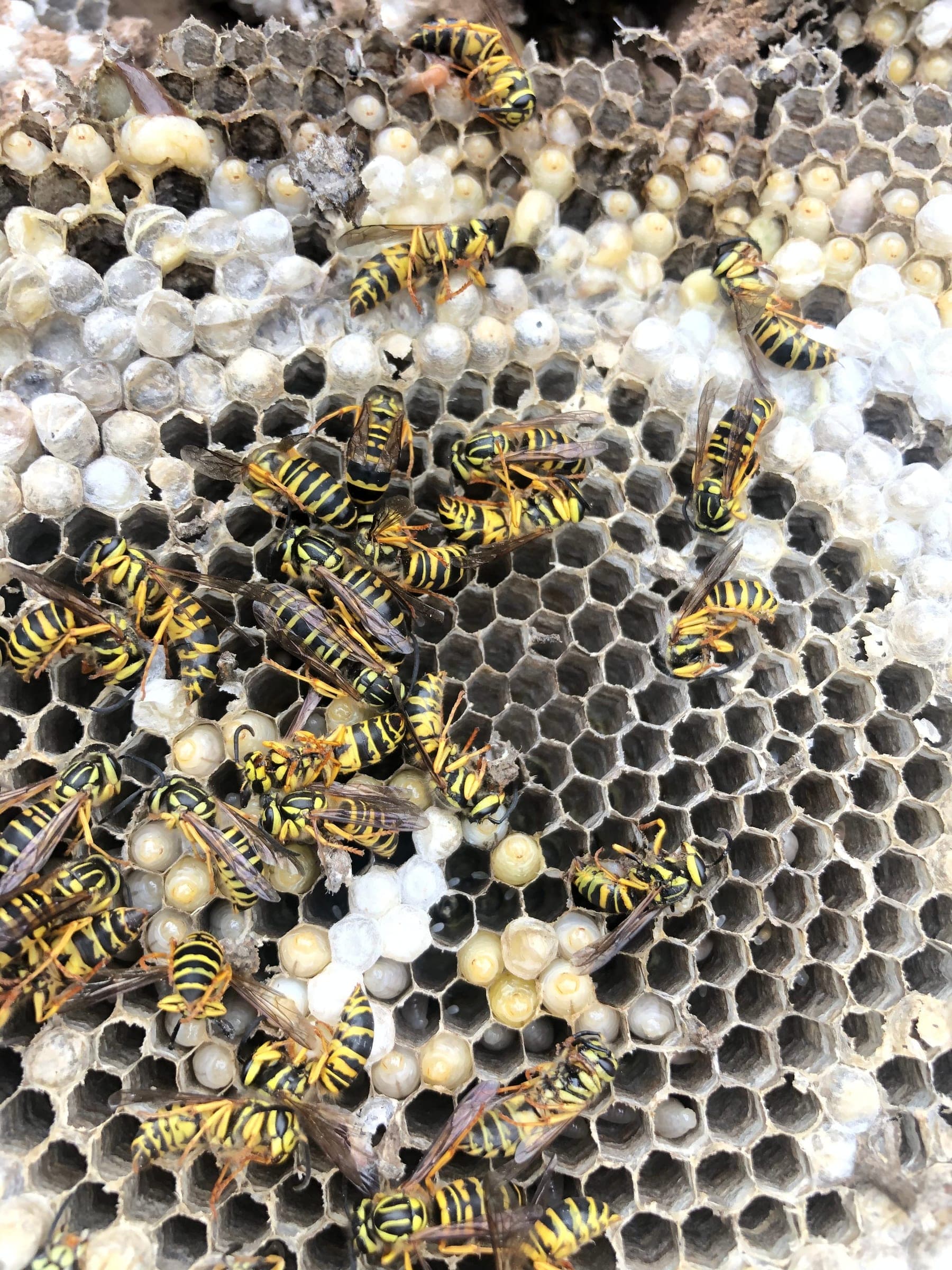
Old rodent burrows, flower beds, the gap under a shed, the edge of a lawn. Common right across DFW and the reason we ask people to stop mowing until we've been. We treat the colony at the source, in the burrow — knocking down what's visible achieves nothing here, because the nest is entirely below you.
Aerial nests — hornets and paper wasps
Eaves, soffits, attic gaps, tree canopies, hose reels, grill lids, stored furniture. A bald-faced hornet nest grows through summer and the ones we get called about in August are frequently basketball-sized. Height and access set the price more than the nest does.
Nests inside the structure
Wall voids, soffits, chimney chases, attic corners. This is where spray-and-hope fails most expensively: you kill the wasps you can reach, the colony continues behind the drywall, and you've spent a fortnight making them defensive. Finding the actual entry and treating the colony where it lives is the whole job.
Nests that keep coming back
Some spots attract a new colony every year — a soffit seam, a persistent burrow, a void with a warm wall. We'll tell you before we start whether yours looks like one of those, what's realistically sealable, and what isn't. Sometimes the honest answer is that this will be an annual call, and you should know that up front rather than after the second one.
Hornets, which people underrate
Hornets get less attention than yellow jackets and deserve more. A bald-faced hornet nest beside a doorway, over a play set, or next to an HVAC unit somebody has to service makes that part of your property unusable, and the nest gets bigger and better defended every week through summer.
We've taken nests the size of a basketball out of attics and trees across the metroplex. It's a job for proper protective equipment and a planned approach, not a can of spray at arm's length off a ladder — the failure mode there is a fall as much as it is stings.
What it costs and how fast we come
You get the exact price before we leave to come out: nest size, species and access decide it, and we can usually work all three out on the phone. No range, no revision on arrival.
Same-day, most days. Tell us if the nest is beside a door you have to use, near children, or if anyone in the house is allergic — those change how we schedule rather than just where you sit in a queue. The work is backed by our written warranty; ask for the current terms when you call.
Yellow jacket and hornet questions we get asked
What's the difference between yellow jackets and hornets?
Are yellow jackets dangerous?
How do I find a yellow jacket nest in the ground?
Can you reach nests in high or awkward spots?
How much does yellow jacket or hornet removal cost?
Will they come back after you treat the nest?
Do they die off in winter anyway?
Where we handle yellow jacket removal
Besides yellow jacket removal, we also handle
Bees won't wait — and neither should you.
Call now for your bee removal needs and you'll have your price before we pull into your driveway. No bait and switch. No pressure. Just the truth and your call — from a beekeeping family that's been doing this for over 45 years.