
Red Wasps in Texas — Identification and Removal
Know what you've got before you call
Telling a red wasp from a yellow jacket, where they build, and when a nest is genuinely worth leaving until frost.
- BBB Accredited A+
- 5-year warranty on hive removal
- Same-day service most days
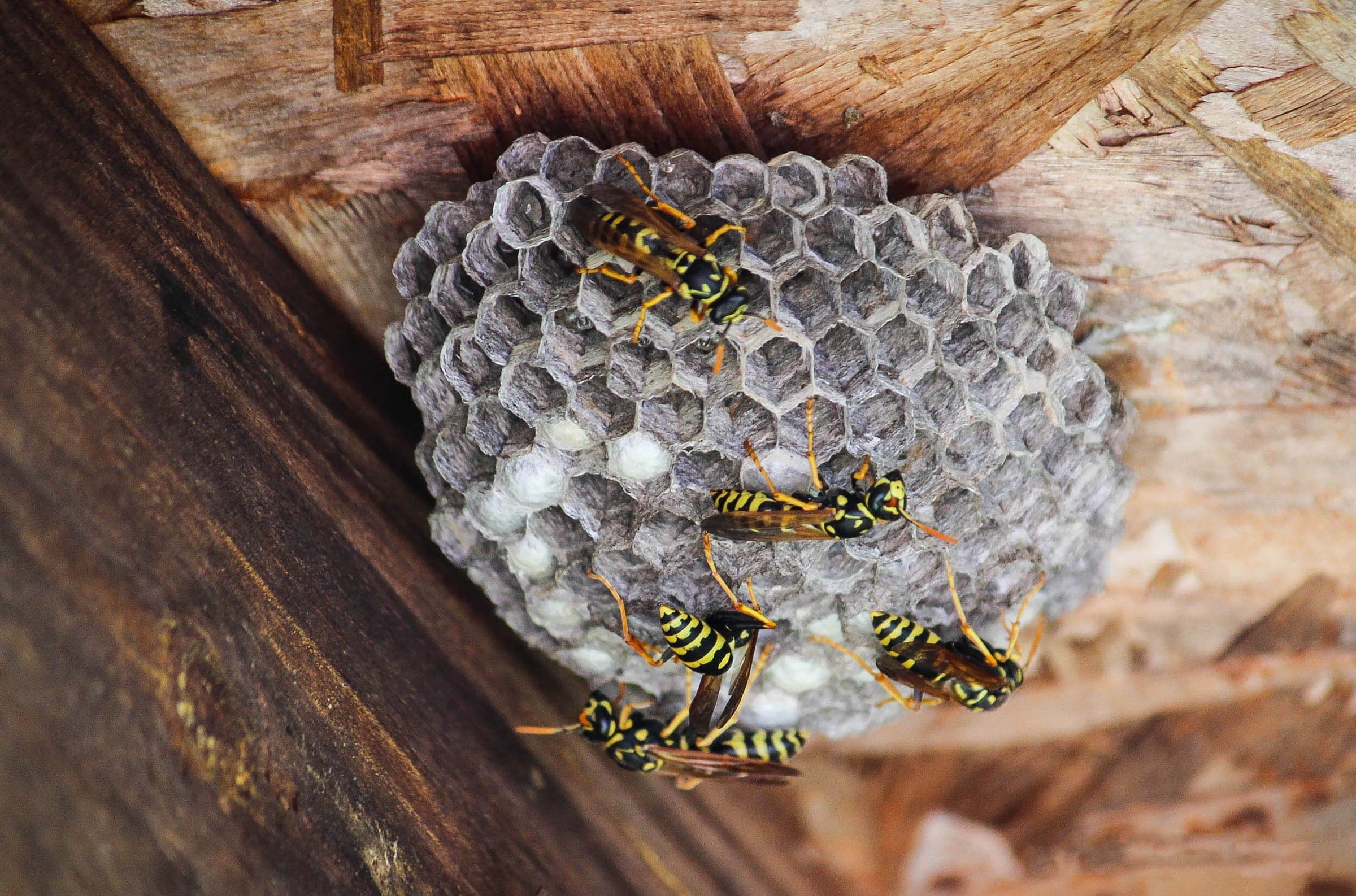
A slim, rusty-red wasp with smoky wings and long trailing legs, building an open umbrella-shaped nest under your eave or deep in a shrub — that's a red wasp. They're a paper wasp, they're all over North Texas from spring through first frost, and they're the single most common wasp call we take.
Here's what actually matters: what you've got, whether it's dangerous to you specifically, and whether it needs dealing with at all.
Red wasp or yellow jacket?
Most people who call about a "red wasp" have one of two insects, and they behave differently enough that it changes what we bring and how urgent it is.
| Tell them apart by | Red wasp (paper wasp) | Yellow jacket |
|---|---|---|
| Colour | Reddish-brown, smoky or dark wings | Bright yellow and black banding |
| Body | Long-legged, slender, pinched waist | Shorter, stockier, less obvious waist |
| Legs in flight | Dangle visibly below the body | Tucked up close |
| Nest | Open umbrella of cells you can see — eaves, shrubs | Hidden — in the ground, in wall cavities; often invisible |
| Aggression | Defends the nest; less frenzied | Very high; swarms fast, especially at a ground nest |
| Stinger | Smooth — stings repeatedly | Smooth — stings repeatedly |
The quickest test is the nest, not the insect. Open honeycomb you can see means paper wasp. A hole in the ground or a gap in the brick with traffic going in and out means yellow jacket, and that's the more dangerous of the two.
Are red wasps dangerous?
The sting hurts more than a honeybee's and they can deliver several. For most people that's a bad afternoon rather than an emergency.
The exception matters more than the rule: if you have a known sting allergy, a red wasp sting can trigger a reaction needing immediate treatment. Don't go near the nest, keep your auto-injector on you, and call 911 if you're stung. Then have someone else deal with the nest — that's a call for us, not a job for you.
Away from the nest, a foraging red wasp isn't interested in you. They're hunting caterpillars and chewing wood fibre. Almost every sting happens within a metre or two of the nest, or because somebody swatted. If one is investigating you, stand still or walk away — swinging at it is what reads as an attack.
Where they nest around a Texas house
Red wasps want shelter, a solid anchor and shade. The nest is a grey-brown papery disc of open cells hanging from a short stalk, and it's usually in plain view once you know where to look:
- Under eaves, overhangs and porch ceilings
- Deep inside dense shrubs and hedges — the one people walk into
- Under deck boards and handrails
- Garage door track channels
- Inside outdoor outlet and junction boxes
- Around window frames and shutters
- Attic vents and soffit gaps
- Under and inside stored patio furniture
Size tells you the season. A golf ball with a handful of wasps is an early-spring nest with one founding queen. By August a good spot can be the width of your hand with a few hundred wasps on it, and that's a different job.
Does it actually need removing?
Sometimes not, and we'll say so.
A nest at the back of the garden that nobody walks past, found in September, will die off at first frost and won't be reused next year. Paper wasps are also decent pest control — they spend the summer taking caterpillars off your vegetables. Leaving that nest alone is a legitimate choice.
Remove it when it's somewhere you can't avoid: over a door you use daily, along a path, in the shrub beside the letterbox, near where children play, on the garage track that moves twice a day. And remove it regardless of location if someone in the house is allergic, because the calculation changes entirely.
DIY or call us — the honest version
A single small nest, reachable standing on the ground, treated after dusk when the colony is home and sluggish, with nobody allergic in the house: that's a reasonable thing to do yourself with a can of wasp spray from a proper distance. We'd rather tell you that than take your money.
Call us instead when the nest is high or needs a ladder, when it's inside a soffit, wall or track where you can't see all of it, when it's large, when it's beside a door or play area, or when anyone in the household reacts badly to stings. Those are the ones where a wrong move costs more than the job would have.
What we do when we come out
We clear the nest, treat the anchor point so the same spot doesn't get rebuilt on within days, and check the immediate area for the satellite nests that usually come with an established one. You get the price before we set off, same-day most days across Dallas–Fort Worth, and the work is backed by our written warranty — ask for the current terms when you call.
Before we leave we'll point out what made that spot attractive. With paper wasps it's usually a sheltered corner you can't do much about, and we'll be honest when that's the case rather than selling you a prevention plan that won't hold.
Red wasp questions we get asked
What does a red wasp look like compared to a yellow jacket?
Are red wasps aggressive?
Do red wasps sting more than once?
Where do red wasps build their nests?
Can I remove a red wasp nest myself?
How much does red wasp removal cost?
When do red wasps disappear for the year?
Where we handle red wasp removal
Besides red wasp removal, we also handle
Bees won't wait — and neither should you.
Call now for your bee removal needs and you'll have your price before we pull into your driveway. No bait and switch. No pressure. Just the truth and your call — from a beekeeping family that's been doing this for over 45 years.